.jpg)
Historical figures of KIT
KIT looks back on a long tradition and a legacy of outstanding figures in climate and environmental research. Systematic meteorological observations began as early as the late 18th century. Following the founding of the Polytechnic in 1825—the predecessor to the University of Karlsruhe and today’s KIT — research in geology and engineering sciences was added to the scope. From these foundations evolved institutes for meteorology, applied geosciences, and civil engineering, which remain of national and international significance to this day. On this page, we have compiled a selection of some prominent figures:
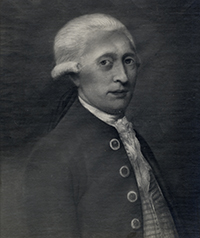
1778 - Johann Lorenz Boeckmann - Meteorology
Significance for Karlsruhe
Meteorological measurements existed even before the founding of the Polytechnic School in 1825: the Baden Meteorological Institute had already been established in 1778 by Professor Johann Lorenz Boeckmann.
Significance for the Field of Meteorology
Nearly 100 years ago, pioneering work was carried out in weather observation, radiation measurement, and visibility measurement. These efforts laid the foundation for a nationwide meteorological measurement network in Germany.
Significance for Society
Today, Karlsruhe Institute of Technology is home to the largest university meteorological institute in Germany.
1807 - Johann Gottfried Tulla - Geodesy

Significance for Karlsruhe
In 1807, Tulla founded an engineering school that was incorporated into the Polytechnic School in 1832. From this institution emerged the Technical University of Karlsruhe in 1885 and, eventually, Karlsruhe Institute of Technology in 2009. Among other achievements, Tulla initiated the first phase of the Baden state survey.
Significance for the Field of Geodesy
Over the past 200 years, renowned representatives of surveying science have worked at the local university. Particularly important was Wilhelm Jordan, who founded Germany’s first geodetic institute in Karlsruhe in the 1870s.
Significance for Society
In the 19th century, land surveying was used to determine the amount of tax to be paid (tax cadastre). In a later step, the cadastre also served as proof of ownership (property cadastre).
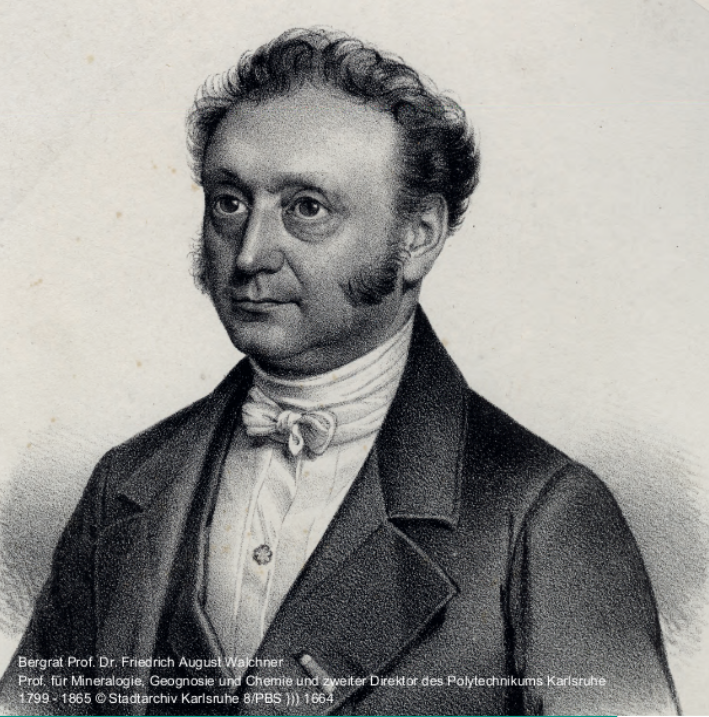
1825 - Friedrich August Walchner - Geology
Significance for Karlsruhe
In 1825, Friedrich August Walchner was appointed as one of the two professors at the newly founded Polytechnic School. From 1833 to 1836, he served as the second director of this predecessor institution of the Karlsruhe Institute of Technology. During his tenure, the main building at Kaiserstraße 12 was constructed. In 1840, Walchner also became a founding member of the “Association for Scientific Communications in Karlsruhe” (“Verein für Naturwissenschaftliche Mittheilungen Carlsruhe”).
Significance for the Field of Geology
In 1829, Walchner published one of the first textbooks at the Polytechnic School, the Handbook of General Mineralogy (Handbuch der gesammten Mineralogie). In the following years, he authored further comprehensive textbooks on geology, mineralogy, and chemistry. In 1839, Walchner drilled for geothermal waters in Bad Rothenfels, and in 1847 he discovered nickel deposits in the Black Forest. In 1851, he initiated the mining of lead, zinc, and silver near Nussloch at the mine later named after him, the Friedrich-August Mine. Walchner was also a member of the Baden Mining Association, founded in Karlsruhe in 1835. The association extracted cobalt and silver from the Saint Anton Mine in the Black Forest, which today hosts the Black Forest Observatory of the KIT.
Significance for Society
From 1833 onward, Walchner was a member of the Baden Estates Assembly. During the Revolution of 1848, he participated in the Frankfurt Pre-Parliament. During this period, he also co-authored the State Lexicon (Staatslexikon) together with the liberal Freiburg professors Karl von Rotteck and Carl Theodor Welcker.
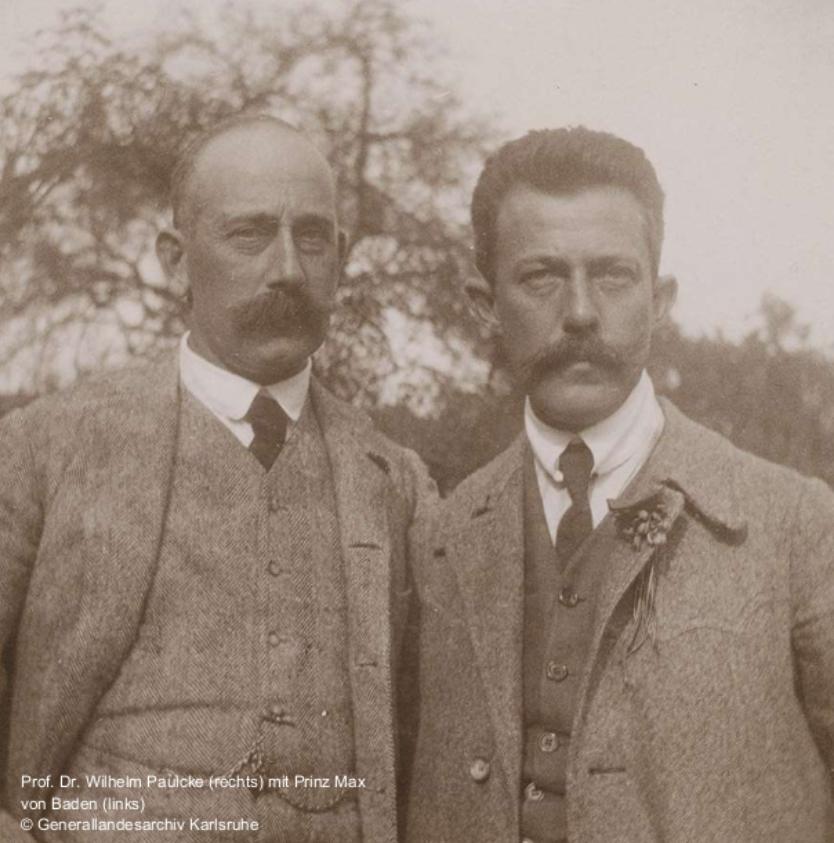
1918 - Wilhelm Paulcke - Geology
Significance for Karlsruhe
In 1918, Wilhelm Paulcke was appointed professor at the Technical University of Karlsruhe, where he shaped geological teaching and research for many years. Through his scientific work and public activities, he contributed significantly to Karlsruhe’s reputation as a center for geosciences and alpine research.
Significance for the Field of Geology
Paulcke was regarded as a pioneer of modern alpine geology and snow research. His studies on glaciers, avalanches, and mountain formations advanced the scientific understanding of high-mountain environments. In addition to his geological work, he also contributed to the development of avalanche science and alpine exploration.
Significance for Society
Beyond academia, Paulcke played an important role in promoting mountaineering and public awareness of alpine safety. His research on snow and avalanches helped improve safety measures in mountainous regions and influenced later developments in avalanche forecasting and prevention.
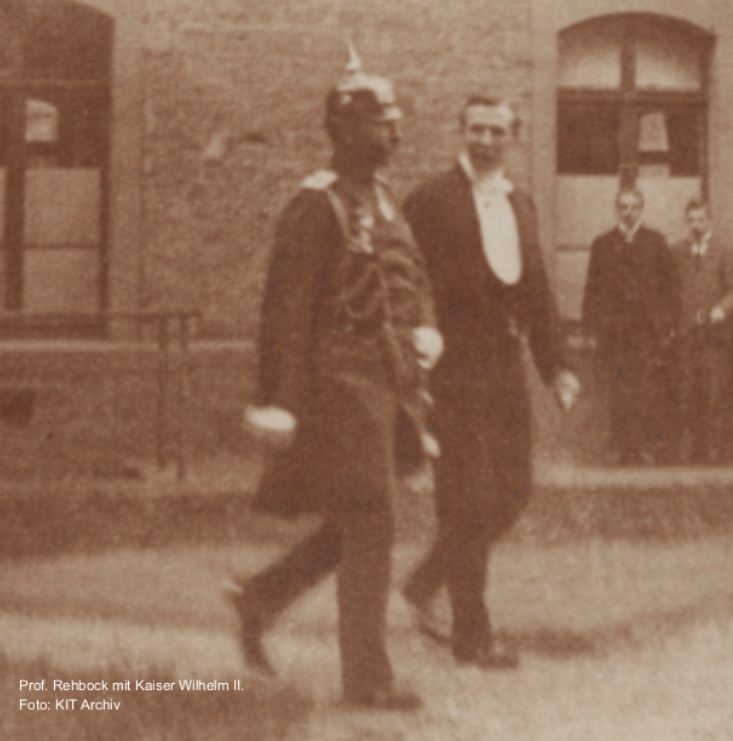
1901 - Theodor Rehbock - Hydraulic Engineering
Significance for Karlsruhe
Hydraulic engineering had already been of great importance at the Polytechnic School since the time of the hydraulic engineers Johann Gottfried Tulla and Max Honsell. Beginning in 1901, the establishment of the River Engineering Laboratory by Theodor Rehbock contributed significantly to the outstanding reputation of the Technical University in the field of hydraulic engineering, far beyond the city limits of Karlsruhe.
Significance for the Field of Hydraulic Engineering
The Theodor Rehbock Hydraulic Engineering Laboratory ranks among the world’s first and most important hydraulic engineering laboratories, alongside the Hubert Engels Laboratory in Dresden (1891) and the Oskar von Miller Laboratory in Obernach (1926). The model laws developed there helped researchers study and optimize the effects of hydraulic engineering measures.
Significance for Society
In 1907, Rehbock designed plans for a hydroelectric power plant on the Murg River. In addition to the river’s natural flow, stored water was also intended to be used for electricity generation. This ensured a stable supply of electricity even during periods of low rainfall. Based on this design, the Rudolf Fettweis Hydroelectric Complex was constructed between 1914 and 1926 as a pumped-storage power plant, including the Schwarzenbach Dam.